

Overview: The Turtle Haven of the South China Sea
Floating off the northeastern coast of Peninsular Malaysia in the state of Terengganu, the Perhentian Islands—comprising the twin islands of Pulau Perhentian Besar (Greater Perhentian) and Pulau Perhentian Kecil (Lesser Perhentian)—represent one of Southeast Asia’s most beloved and ecologically rich marine sanctuaries. Ringed by emerald jungle, granite boulder headlands, and white coral beaches, the islands are surrounded by crystalline waters legally protected under the Department of Fisheries Malaysia Marine Parks Act 1985.
For generations, the Perhentian archipelago has served as a critical nesting haven and feeding ground for Green Sea Turtles (Chelonia mydas) and Hawksbill Turtles (Eretmochelys imbricata) . The calm, sun-drenched coastal waters on the northwestern flank of Pulau Perhentian Besar—specifically Turtle Point (off Teluk Pauh) and Turtle Beach (a protected nesting cove)—harbor expansive benthic seagrass beds and pristine fringing coral reefs.
                        SOUTH CHINA SEA TROPICAL WAVES
                                    │  │  │
                                    ▼  ▼  ▼
       ┌─────────────────────────────────────────────────────────────┐
       │             PULAU PERHENTIAN MARINE PARK RESERVE            │
       │                                                             │
       │     [ Turtle Beach Sanctuary ]       [ Shark Point Reef ]   │
       │   ░░░░░░░░░░░░░░░░░░░░░░░░░░░░       ═════════════════════  │
       │   (Protected Nesting & Nursery)     (Blacktip Reef Sharks)  │
       │                                                             │
       │           [ Turtle Point Shallow Seagrass Pasture ]         │
       │           vvvvvvvvvvvvvvvvvvvvvvvvvvvvvvvvvvvvvvvvv         │
       │           (Green Turtles Grazing in 2.5m - 5.0m Water)      │
       │                                                             │
       │   ───────────────────────────────────────────────────────   │
       │             Perhentian Besar Golden Sand Beaches            │
       └─────────────────────────────────────────────────────────────┘
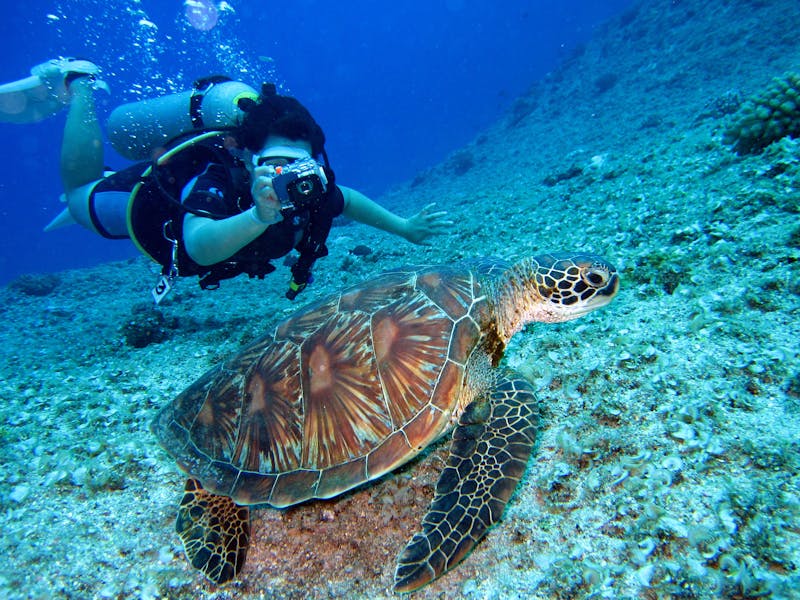
Unlike destinations that require deep scuba excursions, swimming with wild sea turtles in the Perhentians is accessible to snorkelers of all experience levels. You can easily charter a colorful wooden water taxi or book a 3-hour snorkeling excursion from any beach, and within minutes you will be floating above resident Green turtles calmly grazing on ribbon seagrass in 3 to 5 meters of azure water, completely unperturbed by human observers.

Perhentian Islands: 5-Point Snorkeling Adventure (Turtles, Sharks & Coral)
Comprehensive boat tour covering Turtle Point, Shark Point blacktips, Teluk Keke coral gardens, Lighthouse reef, and Fisherman Village.
Marine Biology & Foraging Dynamics in Terengganu
The marine biodiversity of the Perhentians is sustained by lush coastal seagrass meadows that receive continuous sunlight through crystal-clear equatorial waters:
  SURFACE (Snorkeler with Mask & Snorkel) ~~~~~~~~~~~~~~~~~~~~~~~~~~~~~~~~~~~~~~~~
                                          │ (3-Meter Mandatory Standoff Buffer)
                                          ▼
  SEAGRASS FORAGING ZONE                 🐢 [Green Sea Turtle (Chelonia mydas)]
  (Depth: 2.5m - 6.0m)                    │ Grazing on Halophila & Cymodocea shoots
                                          ▼
  BENTHIC SEAGRASS BEDS                  vvvvvvvvvvvvvvvvvvvvvvvvvvvvvvvvvvvvvvvv
                                         Halophila ovalis & Cymodocea serrulata
                                         Acropora table corals & Porites bommies
1. The Green Sea Turtles (Chelonia mydas) of Turtle Point
The Green turtles that frequent Turtle Point (between the Perhentian Island Resort pier and the northern headland) are primarily large sub-adults and breeding adults.
The seabed here consists of fine white carbonate sand carpeted by dense patches of Paddle Grass (Halophila ovalis), Serrated Ribbon Seagrass (Cymodocea serrulata), and Sickle Seagrass (Thalassia hemprichii). Green turtles spend their mornings gliding across the bottom, systematically cropping tender young shoots. Because local tour boat captains are educated by marine park rangers to cut their boat engines and maintain idle speed near the buoyed feeding zone, the turtles remain remarkably calm and peaceful during feeding sessions.
2. The Hawksbill Turtles (Eretmochelys imbricata) of Teluk Keke & Batu Nisan
Along the boulder-strewn coral gardens of Teluk Keke and the northern tip of Perhentian Kecil (Batu Nisan), Hawksbill turtles hunt among massive Brain Corals (Platygyra), Pore Corals (Porites lutea), and sprawling Acropora Table Corals. Hawksbills use their narrow beaks to extract encrusting sponges and small sea anemones from granite crevices, preventing sponge overgrowth and maintaining hard coral health.
Symbiotic Cleaning Stations & Reef Inhabitants
Scattered around Turtle Point are established coral cleaning stations where Bluestreak Cleaner Wrasses (Labroides dimidiatus) and juvenile Moon Wrasses (Thalassoma lunare) service resting turtles.
Other iconic marine life in the Perhentian Marine Park:
- Blacktip Reef Sharks (Carcharhinus melanopterus): Harmless, graceful 1-to-1.5 meter sharks cruising the shallows at Shark Point (Teluk Dalam).
- Anemone Gardens: Extensive beds of sea anemones hosting False Clownfish (Amphiprion ocellaris) and Clark’s Anemonefish (Amphiprion clarkii).
- Stingrays & Trevallies: Blue-spotted Ribbontail Rays (Taeniura lymma) resting under coral ledges, and schools of Bigeye Jacks (Caranx sexfasciatus).
Detailed Bathymetry, Reef Zones & Snorkel Swim Routes
WEST (Turtle Point)                  CENTER (Shark Point)                   EAST (Teluk Keke)
[ Shallow Seagrass Flats ]         [ Boulder Reef & Sand Chute ]          [ Fringing Coral Garden ]
     Depth 2.0-6.0m                        Depth 3.0-10.0m                        Depth 1.5-7.0m
           │                                      │                                      │
        vvvvvvvv                               ════════                               ════════
 (Green Turtle Grazing)                 (Blacktip Sharks / Rays)               (Hawksbills & Anemones)
                  PERHENTIAN BESAR TURTLE POINT SNORKEL ROUTE

  [ Beachfront in Front of Perhentian Island Resort (PIR) ]
          │  Step directly into water at medium-to-high tide
          ▼
  [ Shallow Sand Flat (1.0m - 2.0m) ]  --> Wade past wave zone; put on mask & fins
          │  Swim 60m-80m offshore toward the yellow boat-channel buoys
          ▼
  [ Core Turtle Point Seagrass Meadow (3.0m - 5.0m) ] --> 3 to 8 Green Turtles Feeding 🐢
          │  Float horizontally on surface; maintain 3-meter mandatory buffer
          ▼
  [ Northern Coral Bommie Ridge (4.0m - 8.0m) ]     --> Active Wrasse Cleaning Stations
          │  Swim back southward parallel to the beach
          ▼
  [ Exit Safely onto PIR Powder-White Sand Beach ]
1. Turtle Point (Teluk Pauh, Perhentian Besar)
- Depth Profile: 2.5 to 6.0 meters.
- Bottom Type: Pure white sand with dense patches of Halophila seagrass.
- Wildlife Encounter: The primary feeding hub for Green turtles. You can reach this spot by swimming straight out from PIR beach or taking a 5-minute water taxi from Coral Bay / Long Beach on Perhentian Kecil.
2. Turtle Beach (Pulau Perhentian Besar)
- Depth Profile: 1.5 to 5.0 meters.
- Bottom Type: Sheltered, deserted white sand cove backed by dense jungle cliffs.
- Wildlife Encounter: Prime nesting beach for Green turtles. By day, the fringing reef offers crystal-clear snorkeling with Hawksbills and schools of juvenile reef fish. Night visits are strictly prohibited to protect egg-laying females.
3. Shark Point & Teluk Keke
- Depth Profile: 2.0 to 9.0 meters.
- Bottom Type: Granite boulders intermixed with hard Acropora table corals.
- Wildlife Encounter: Spot harmless Blacktip Reef Sharks swimming peacefully in 2 to 4 meters of water, alongside grazing Hawksbill turtles and giant parrotfish.
Perhentian Private Snorkel Boat Charter (Custom 6 Stops)
Private wooden boat charter for up to 6 people covering Turtle Point, Shark Point, Teluk Keke, Romantic Beach, and Blue Lagoon.
Marine Sanctuary Laws, Conservation Passes & Fines
The Perhentian Islands are protected under the Fisheries Act 1985 (Part IX - Marine Parks and Marine Reserves):
Department of Fisheries Malaysia Marine Park Rules (tracked by SWOT ):
- Mandatory Marine Park Conservation Fee: All visitors must purchase an official Marine Park ticket at the Kuala Besut Jetty counter before boarding the boat: 30 MYR (~$6.50 USD) for foreign adults (15 MYR child) or 5 MYR for Malaysian citizens.
- Strict [3-meter buffer](/ethics-and-safety/): Touching, restraining, riding, or harassing sea turtles is strictly illegal under Malaysian Federal Law. Violations carry fines of up to 20,000 MYR (~$4,500 USD) and potential imprisonment under the Wildlife Conservation Act.
- Protected Turtle Nesting Sanctuary: Turtle Beach (Teluk Dalam) is an active government research reserve. Entering nesting beaches after 19:00 without authorized Department of Fisheries rangers is strictly prohibited.
- Zero Anchoring on Coral Reefs: Boats must tie strictly to designated mooring buoys. Dropping anchors onto living coral substrate is a federal offense.
- No Spearfishing or Collection: Taking any shells, corals, or marine life from the national park is strictly banned.
Seasonality, Water Temperatures & Monsoon Windows
Month:      Jan  Feb  Mar  Apr  May  Jun  Jul  Aug  Sep  Oct  Nov  Dec
Sighting:  [ CLOSED MONSOON ] [======== Peak Season 98% ========] [ CLOSED MONSOON ]
Conditions: Rough Seas (Closed) Dry Southwest Monsoon (Calm Seas) Monsoon Swells
Water Temp: 27°C 27°C 28°C 29°C 30°C 30°C 30°C 29°C 29°C 28°C 27°C 27°C
Visibility:   5m   8m  18m  25m  25m  25m  25m  25m  25m  18m   8m   5m
- Open Dry Season (March through October): The prime operational window. The South China Sea is calm, turquoise, and glassy. Underwater visibility consistently ranges from 18 to 25+ meters, and water temperatures hover around 29°C to 31°C. Turtle sightings at Turtle Point peak between April and September.
- Monsoon Closure (November through February): The Northeast Monsoon brings heavy ocean swells, torrential rainfall, and strong winds. The entire marine park is effectively closed: all regular ferry services from Kuala Besut cease, and nearly all beachfront resorts and dive shops shut down for annual maintenance.
Complete Logistics: How to Get to the Perhentian Islands
[ Kuala Lumpur (KUL) / Singapore (SIN) ] ──── Flight (55 min) ───► [ Kota Bharu Airport (KBR) ]
                                                                             │
                                                                       Taxi / Van (50 min)
                                                                             ▼
[ PERHENTIAN ISLANDS (Besar / Kecil) ] ◄── Speedboat (35 min) ── [ Kuala Besut Jetty ]
1. Gateway Airports & Domestic Flights
- Fly into Kota Bharu (Sultan Ismail Petra Airport - KBR): The nearest and most convenient gateway. Daily 55-minute flights operate from Kuala Lumpur (KUL/SZB) via Malaysia Airlines, AirAsia, and Batik Air, as well as direct flights from Singapore.
- Alternative: Kuala Terengganu Airport (TGG): Located 1.5 hours south of Kuala Besut Jetty.
2. Overland Transfer to Kuala Besut Jetty
- Airport Taxi / Grab: Take a private taxi or Grab car from Kota Bharu Airport directly to Kuala Besut Jetty (approx. 45 to 55 minutes; fixed fare: 75–90 MYR / $16–$20 USD per vehicle).
3. Speedboat Crossing to the Islands
- Speedboat Departures: Modern passenger speedboats depart Kuala Besut Jetty frequently between 08:00 and 17:00 (fare: 70 MYR / $15 USD round-trip per person).
- Transit Duration: 30 to 40 minutes. The boat captain will drop you off directly at the beach or wooden pier of your chosen resort on either Perhentian Besar or Perhentian Kecil.
Realistic Pricing Benchmarks & Verified Local Operators
| Service / Item | MYR (Malaysian Ringgit) | USD Equivalent ($) | Notes / Inclusions |
|---|---|---|---|
| Marine Park Conservation Pass | 30 MYR | $6.50 | Paid at Kuala Besut Jetty counter |
| Mask & Snorkel Rental (Full Day) | 10 – 15 MYR | $2.20 – $3.30 | From beachfront dive centers |
| Fins Rental (Full Day) | 10 – 15 MYR | $2.20 – $3.30 | Recommended for open water swimming |
| Shared 5-Point Snorkel Boat Trip | 50 – 70 MYR | $11.00 – $15.50 | 3-4 hours, 5 stops (Turtles, Sharks, Corals) |
| Private Snorkel Boat Charter | 250 – 350 MYR | $55.00 – $78.00 | Up to 6 pax; flexible schedule |
| Single Guided Scuba Boat Dive | 100 – 130 MYR | $22.00 – $29.00 | Includes full gear, boat & divemaster |
Verified Local PADI 5-Star Operators
- Anti Gravity Divers Perhentian
- Accreditation: PADI 5-Star Dive Center #32219
- Website: https://antigravitydivers.com | Email: info@antigravitydivers.com | Phone: +60 19 938 1819
- Location: Coral Bay, Pulau Perhentian Kecil, Terengganu 22300
- Highlights: Highly acclaimed dive center known for professional instructor staff, high safety standards, and dedicated marine conservation briefings.
- Turtle Bay Divers
- Accreditation: PADI 5-Star Career Development Center (CDC) #6297
- Website: https://turtlebaydivers.com | Email: info@turtlebaydivers.com | Phone: +60 9 691 1689
- Location: Long Beach, Pulau Perhentian Kecil
- Highlights: Established in 1999. Offers PADI courses from Beginner to Instructor level, top-tier rental equipment, and daily guided dive/snorkel boats.
- Universal Diver Perhentian
- Accreditation: PADI 5-Star Resort #36411
- Website: https://universaldiver.net | Email: info@universaldiver.net | Phone: +60 17 978 2559
- Location: Teluk Pauh Beachfront, Pulau Perhentian Besar
- Highlights: Located directly in front of the famous Turtle Point reef flat, offering the fastest direct access to morning sea turtle encounters.
Responsible Snorkeling Guidelines for the Perhentians
                    RESPONSIBLE PERHENTIAN ENCOUNTER PROTOCOLS

     Snorkeler Floating Horizontally (No Splash, No Grab)
     ~~~~~~~~~~~~~~~~~~~~~~~~~~~~~~~~~~~~~~~~~~~~~~~~~~~
                              │
                              │  3 METERS (10 FEET) MINIMUM BUFFER
                              │  ZERO PHYSICAL TOUCHING
                              ▼
                   🐢 [Green Sea Turtle]
                              │
                              ▼
        [ Halophila Seagrass Pasture in 4m Water ] vvvvvvvvvvvv
- Never Hover Directly Above a Grazing Turtle: When a turtle needs to breathe, it must swim vertically to the surface. If a snorkeler blocks its path, the animal will suffer acute hypoxia stress. Always float at an angle off to the side.
- Move Slowly with Calm, Gentle Kicks: Vigorous kicking creates loud underwater acoustic pressure waves that trigger the turtle’s defensive fight-or-flight response.
- No Plastic Waste: Always pack out all food wrappers, plastic water bottles, and cigarette butts.
- Wear UV Rashguards: Eliminate chemical reef-safe mineral sunscreen pollution by wearing long-sleeve UPF 50+ swimwear.
Red Flags & What to Avoid at Perhentian Besar
Red Flags & What to Avoid at Perhentian Besar (Turtle Beach & Turtle Point)
Independent critique, common tourist traps, and local marine compliance advisories.
At Perhentian Besar (Turtle Beach & Turtle Point), underwater clarity is highest during Morning 08:30-11:30 (15–25m). By late morning, coastal winds kick up chop and tourist activity stirs bottom sediments, cutting visibility significantly. Resident sea turtles typically retreat to deeper resting ledges once human traffic peaks.
Shore access at Perhentian Besar (Turtle Beach & Turtle Point) has an official fee of $6.50 USD. Independent beach touts often approach visitors claiming private guides or expensive package wristbands are required. Verify official ticket counters and bring your own sanitized snorkel gear to avoid paying 300% rental markups.
Wild sea turtles at Perhentian Besar (Turtle Beach & Turtle Point) are protected by national marine sanctuaries. Minimum 3-meter distance from turtles. Touching, cornering, riding, or feeding turtles carries severe statutory wildlife fines, immediate park ejection, and potential legal prosecution under Malaysia conservation laws.
Chemical sunscreens containing oxybenzone, octinoxate, and octocrylene poison fragile coral polyps and marine turtle nursery habitats. Use exclusively certified 100% non-nano zinc oxide mineral sunscreens or wear UPF 50+ rashguards to prevent sunscreen wash-off in the protected reef zone.
Frequently Asked Questions & Direct Choice Field Guide
Guided Tour vs Independent Shore Snorkeling in Perhentian Besar — Which should you book?
Book a guided excursion (from $52 USD) if you want guaranteed encounters, boat access to outer reefs, certified safety skippers, and high-quality snorkel gear; choose independent shore snorkeling ($6.50 USD) only if you are an experienced ocean swimmer equipped with your own reef-safe gear and comfortable navigating local shore breaks and current corridors.
Guided tours provide dedicated spotters who know current turtle feeding clusters, whereas independent snorkelers often waste hours searching murky shallows.
Early Morning vs Midday Snorkeling — When is turtle sighting probability highest?
Go during Morning 08:30-11:30, which delivers an optimal 95% sighting probability and crystal 15–25m underwater visibility before offshore trade winds churn bottom sediments and tourist crowds arrive.
After 11:00 AM, heavy boat traffic and hundreds of recreational swimmers stir up fine silt, reducing underwater clarity by up to 50% and driving grazing turtles into deeper offshore trenches.
Peak Season (April, May, June) vs Shoulder Months — When are water conditions best?
Visit during April, May, June for peak feeding activity, minimal rainfall, and warm sea temperatures ranging from 28°C to 31°C.
While resident sea turtles inhabit Perhentian Besar year-round, booking morning excursions during peak months ensures calm surface conditions, though reserving tour slots 2–3 weeks ahead is essential to avoid sold-out capacity limits.
What are the statutory wildlife distance rules and legal penalties in Malaysia?
Swimmers must maintain a strict minimum 3-meter (10-foot) buffer from all sea turtles at all times under Malaysia marine conservation laws.
Touching, riding, pursuing, or cornering a turtle is a serious wildlife violation carrying steep statutory fines, immediate ejection from the marine sanctuary, and potential criminal prosecution. Always float neutrally with your arms crossed across your chest and allow turtles an unobstructed 45-degree surfacing corridor to breathe.
Where do Perhentian Besar turtle tours depart from, and how do you reach the reef?
Most verified excursions depart directly from local harbor docks or designated beach kiosks near KBR airport, with reef access centered around GPS coordinates 5.9011, 102.7567.
If traveling independently by rental car or taxi, arrive at least 30 minutes before your scheduled departure to secure parking and complete mandatory marine sanctuary registration.